Blog
Is Olive Oil Safe for Dogs? Fat, Calories and When to Skip It
A small amount of olive oil is fine for most healthy dogs, but it is pure fat. One 2 mL Mighty K9 serving adds 16.2 kcal. Skip it, or ask your vet first, if your dog has had pancreatitis, is on a low-fat or weight-loss diet, or has loose stools (Steiner, Merck Veterinary Manual, 2025)(Animal Medical Center, n.d.).
Written by the Mighty K9 editorial teamUpdated · 9 min read
Short answer
Can dogs have olive oil?
Yes, most healthy dogs can have a little olive oil. The catch is that oil is 100% fat, and fat is the most calorie-dense part of any diet.
Olive oil is not toxic to dogs. People add it to bowls for shine, taste or a softer stool. Many supplements, including Mighty K9, use it as a carrier.
The real question is how much fat and how many calories your dog can handle. For some dogs, very little.
The numbers
How much fat and how many calories are in olive oil?
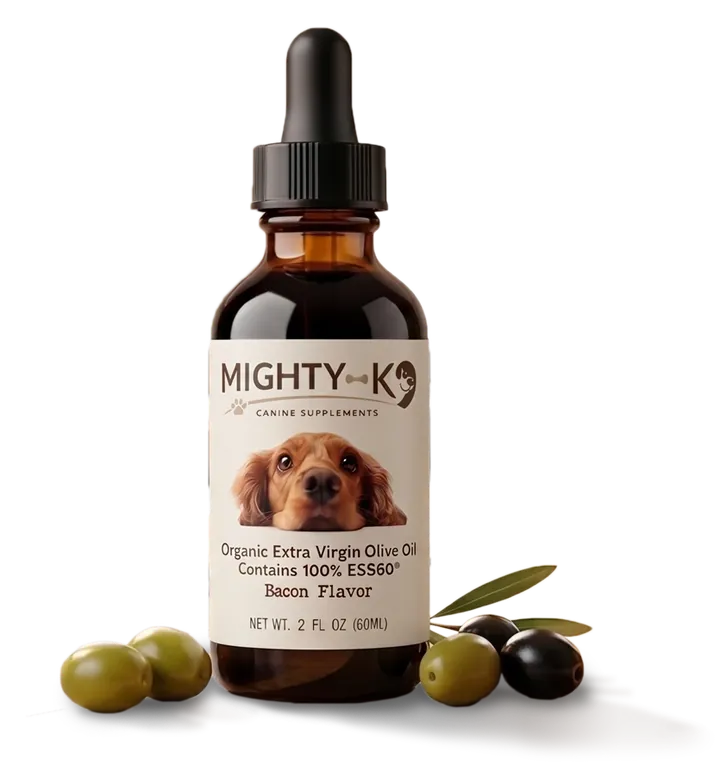
Olive oil is close to pure fat, and the Mighty K9 label says so. Its guaranteed analysis lists crude fat at 100% (min), with 0% protein and 0% fiber.
The label states 8,100 kcal ME/kg; 16.2 kcal ME per 2 mL serving (calculated). Those numbers are minimums, maximums and calculated values, not lab-exact amounts (AAFCO, n.d. (reading labels)). Still, they are useful, and many oil supplements print no calories at all.
| Crude fat | 100% (min) |
|---|---|
| Calories | 16.2 kcal ME |
| Fat per serving | About 1.8 g (our estimate, from 2 mL of oil) |
| Main ingredient | Extra virgin olive oil |
| Other ingredients | ESS60 (1.6 mg) and bacon flavor |
| Warnings on the label images | Not printed |
The label images we have show no warnings or directions. Check the physical bottle for anything printed there.
By size
How much does 2 mL of olive oil add for my dog's size?
One serving adds little for a large dog. For a toy dog, it can be a meaningful share of the day. The table uses resting energy needs, 70 x kg to the 0.75 power (Carlson, Today's Veterinary Nurse, 2023), as a cautious baseline.
| Dog size | Resting needs (kcal a day) | Share from one serving | Left in a 10% extras budget |
|---|---|---|---|
| 3 kg (7 lb) | About 160 | About 10% | Almost nothing |
| 5 kg (11 lb) | About 234 | About 7% | About 7 kcal |
| 10 kg (22 lb) | About 394 | About 4% | About 23 kcal |
| 20 kg (44 lb) | About 662 | About 2.4% | About 50 kcal |
| 30 kg (66 lb) | About 898 | About 1.8% | About 74 kcal |
Treats and extras should stay under 10% of daily calories (Tufts Your Dog, n.d.). Count the oil there, with the biscuits and chews. Small-dog owners should check the sales-page serving guide and ask their vet, because the label gives one 2 mL serving size for all dogs. More on that on our serving size page.
The big risk
Can olive oil cause pancreatitis in dogs?
High-fat foods are a known risk factor for pancreatitis in dogs, and a spoon of oil is about as high-fat as food gets. The Animal Medical Center lists high-fat foods, including table scraps, as a risk (Animal Medical Center, n.d.).
The Merck Veterinary Manual calls dietary indiscretion a common risk factor in dogs. It also names very high blood fats (triglycerides) as a risk. Dogs recovering from pancreatitis are put on low-fat diets, under 20 g of fat per 1,000 kcal (Steiner, Merck Veterinary Manual, 2025).
If your dog has ever had pancreatitis, has high triglycerides or eats a low-fat prescription food, do not add any oil without your vet's OK. Signs of a flare include vomiting, belly pain, poor appetite, weakness and diarrhea (Animal Medical Center, n.d.). Those need a vet the same day.
A single 2 mL serving is a small amount of fat for a healthy large dog. For a dog on a strict fat budget, every gram matters.
Digestion
Does olive oil cause diarrhea or loose stools in dogs?
It can. Any new fat can loosen stools in some dogs, especially when started at a full amount or on an empty stomach.
- Mix it into a meal, as the sales FAQ suggests, rather than giving it alone.
- Start with part of a serving for a few days if your dog has a sensitive stomach, after checking with your vet.
- Do not add oil while a dog already has an upset stomach.
- Stop and call your vet if loose stools last more than a day or two, or if vomiting starts.
Some owners use oil to soften hard stools. Constipation can have medical causes, so ask your vet before using oil for it.
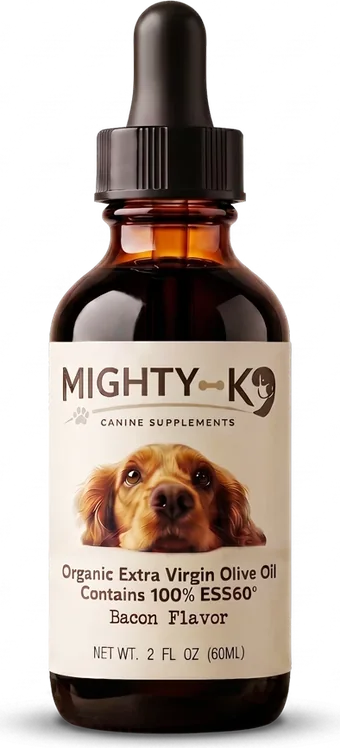
Try Mighty K9 for 30 days2 mL a day · $64.99 a bottle · free shipping over $100 · empty bottles OK for refunds
Order nowComparison
Is olive oil or fish oil better for dogs?
For joints, fish oil has the evidence and olive oil does not. Fish oil supplies the omega-3s EPA and DHA. Olive oil is mostly a different fat, oleic acid, and is not a meaningful EPA or DHA source.
| Question | Olive oil | Fish oil |
|---|---|---|
| Main fat type | Monounsaturated (oleic acid) | Omega-3 (EPA and DHA) |
| Dog joint trials | None found | Randomized trials and reviews (Roush et al., 2010)(Barbeau-Gregoire et al., 2022) |
| Review verdict | Not assessed | The one nutraceutical with reasonable evidence (Vandeweerd et al., 2012) |
| Calories | Yes, pure fat | Yes, also pure fat |
| Pancreatitis caution | Yes | Yes |
Fish oil is still fat, so the same calorie and pancreatitis cautions apply. The effect in trials was modest (Roush et al., 2010). Ask your vet about an omega-3 product or a joint diet if stiffness is the worry. Our omega-3 vs C60 post goes deeper.
Quick check
When should I not give my dog olive oil?
Skip it, or ask your vet first, if any of these apply. Answer the five questions for a quick read on your own dog.
The checklist is not a diagnosis. Your vet knows your dog's history, weight and medicines. Bring the bottle or a photo of the label panel to the visit.
Bottom line
So, is olive oil safe for my dog?
For a healthy adult dog at a good weight, a 2 mL serving mixed into a meal is a small, counted extra. For a dog with a pancreatitis history, a weight problem or a touchy stomach, ask your vet before adding any oil, Mighty K9 included.
FAQ
Olive oil for dogs: common questions
How much olive oil can I give my dog a day?
There is no single safe number for every dog. Count oil as an extra and keep all extras under 10% of daily calories (Tufts Your Dog, n.d.). One 2 mL Mighty K9 serving is 16.2 kcal. For small dogs, puppies or dogs with health issues, ask your vet.
Can I give my dog olive oil every day?
Many healthy dogs can have a small daily amount if the calories are counted. The sales FAQ says to mix Mighty K9 into food once a day. Daily oil is not a good idea for dogs with a pancreatitis history or on a low-fat diet (Steiner, Merck Veterinary Manual, 2025).
Is olive oil good for a dog's coat?
Some owners add oil for coat shine, but we found no dog trials showing olive oil improves skin or coat. If your dog has itchy or flaky skin, see your vet. Skin problems often have causes, such as allergies or parasites, that oil will not fix.
Does olive oil help constipation in dogs?
Oil can soften stools in some dogs, but constipation can signal a medical problem. Ask your vet before using oil for it, especially if your dog strains, vomits or stops eating. Do not use oil as a home fix for a dog that has not passed stool in a day or two.
Can olive oil make a dog sick?
Yes, in some dogs. Too much fat can cause loose stools or vomiting, and high-fat foods are a risk factor for pancreatitis (Animal Medical Center, n.d.). Stop the oil and call your vet if your dog vomits, has diarrhea, stops eating or seems to have belly pain.
Who wrote this
Written and reviewed by
Plain-language pages built from the bottle label, the sales page and linked veterinary and government sources.
Last updated . Read our editorial standards and how we check reviews. This website is run by a U.S. retail partner, not by the manufacturer. This site is paid a commission when you buy through our order links.
Keep reading
More about Mighty K9

U.S. retail partner for Mighty K9
Ready to try Mighty K9?
Pick a pack. One 2 mL serving a day in your dog's food, and every pack covers the 30-day money-back window.
- Secure checkout
- 30-day money-back
- Ships from the U.S.