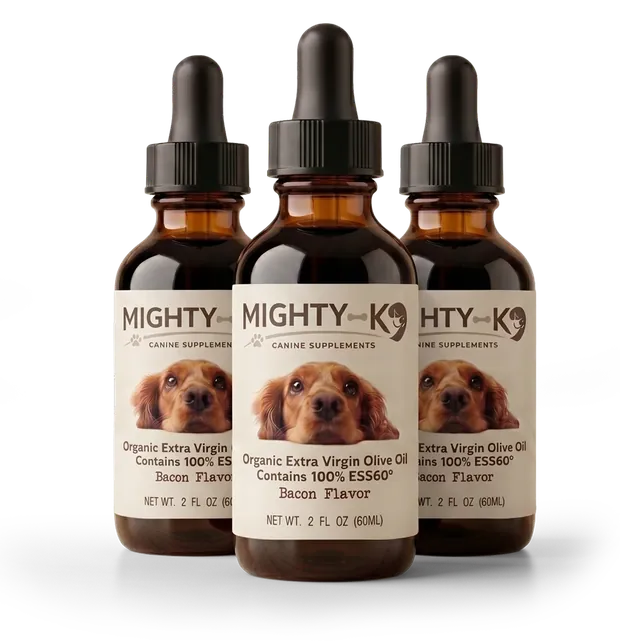
Blog
Signs of Arthritis in Dogs: What Owners Notice First, and When to Call the Vet
Early signs of arthritis in dogs are often quiet: pausing at stairs, skipping car jumps, getting up slowly, licking a joint, shorter walks and thinner thigh muscles (Harari, Merck Veterinary Manual (Pet Owner), 2025). A limp lasting more than a day or two needs a vet (Cornell Riney Canine Health Center, n.d.). Treatment rests on vet-chosen pain relief, weight, diet and exercise. Supplements like Mighty K9 are not a substitute.
Written by the Mighty K9 editorial teamUpdated · 9 min read

At home
What are the first signs of arthritis in dogs?
The first signs are usually small changes in routine, not a dramatic limp. Owners often notice habits before pain.
Veterinary sources list limping, stiffness, joint swelling and muscle loss as classic signs of osteoarthritis (Harari, Merck Veterinary Manual (Pet Owner), 2025). At home, they tend to look like this:
- Stairs: your dog pauses at the bottom, takes them one at a time, or stops using them.
- Car jumps: your dog waits to be lifted or tries twice before jumping in.
- Slow to rise: getting up after a nap takes longer, often worse in the morning or after cold weather.
- Licking a joint: repeated licking of a wrist, knee or hip can be a sign of discomfort.
- Shorter walks: your dog lags behind, sits down mid-walk, or turns for home early.
- Muscle loss: the back legs look thinner, or the spine and hip bones feel easier to find.
Several signs together, building over months, are worth a vet visit.
Keep notes
How do you record arthritis signs for your vet?
Write down what you see and when. A log turns "he seems slower" into facts.
| Sign | What you might see | What to write down |
|---|---|---|
| Stairs | Hesitating, one step at a time | Which stairs, how many, up or down |
| Car or couch jumps | Waiting to be lifted | Date it started, how often |
| Rising | Slow, stiff first steps | Morning vs evening, after rest or exercise |
| Licking | Focus on one joint | Which leg, any redness or swelling |
| Walks | Lagging, sitting, turning back | Usual distance vs now, in minutes |
| Muscle | Thinner thighs or hips | Photos from the side, a month apart |
A short phone video of your dog walking and getting up helps a lot. Cornell's canine health center says home videos of a limp are useful at the visit (Cornell Riney Canine Health Center, n.d.).
Do not wait
When is limping in a dog an emergency?
Severe, sudden or worsening pain, or a dog that will not put weight on a leg, should be seen right away. A milder limp that lasts more than a day or two also needs a visit (Cornell Riney Canine Health Center, n.d.).
Crying out when touched, a leg held off the ground, a swollen or hot joint, or limping after a fall. These need an exam, not a supplement.
Never give your dog human pain relievers such as ibuprofen, naproxen, aspirin or acetaminophen without calling your vet. Dogs process them differently, and they can cause ulcers and kidney or liver damage (FDA, n.d. (pain relievers)). If your dog already swallowed one, call your vet or the ASPCA Animal Poison Control Center at (888) 426-4435; a fee may apply (ASPCA, n.d.).
Why it happens
What causes arthritis in dogs?
In dogs, arthritis often starts early in life. Veterinary experts say it mostly grows out of developmental joint problems, such as hip or elbow issues, rather than age alone (AVMA JAVMA News, 2021).
Body weight plays a big part. In a 14-year study of Labrador Retrievers, dogs fed about 25% less food stayed leaner. By age 10, hip arthritis showed up in 42% of the lean dogs versus 79% of the others (Penn Today, 2002). The lean group also lived a median of about 1.8 years longer (Kealy et al., 2002).
With 59% of U.S. dogs overweight or obese in a 2022 survey (APOP, 2022), weight is worth a frank talk with your vet. Our weight and joint health guide covers it in detail.
The exam
What does the vet do to check for arthritis?
The vet watches your dog move, then examines the joints by hand. From there, tests depend on what they find (Cornell Riney Canine Health Center, n.d.).
Watch the gait
Your dog walks and trots so the vet can see which leg is favored and how much.
Hands-on exam
The vet flexes each joint, feels for swelling, and checks nerves and reflexes.
Imaging
X-rays show joint changes. Some dogs need more advanced imaging.
Lab work
Bloodwork checks overall health before long-term medicine. Joint fluid may be tested.
Bring your log, videos and a list of all supplements and treats.
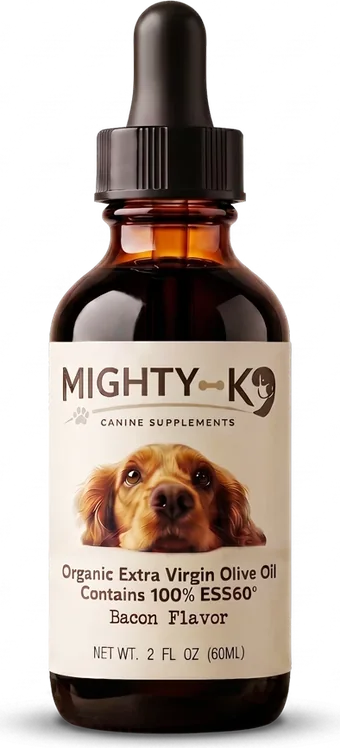
Try Mighty K9 for 30 days2 mL a day · $64.99 a bottle · free shipping over $100 · empty bottles OK for refunds
Order nowTreatment
What are the four pillars of arthritis care in dogs?
Experts describe four pillars that work together: pain relief, weight, diet and exercise (AVMA JAVMA News, 2021).
Pain relief
Chosen by your vet, often an NSAID made for dogs, with blood tests over time (FDA, n.d. (pain relievers)).
Weight
A lean body puts less load on sore joints.
Diet
The right calories, and often added omega-3s.
Exercise
Regular, gentle movement on soft ground (Harari, Merck Veterinary Manual (Pet Owner), 2025).
Supplements
Where do supplements fit with dog arthritis?
Supplements sit at the edge of the plan, not the center. Among joint supplements, only omega-3 fish oil shows reasonable evidence in dogs (Vandeweerd et al., 2012).
Prescription options exist too. A monthly vet injection for arthritis pain, Librela, was approved by the FDA in May 2023 (FDA, 2023 (Librela)). Mighty K9 is different: olive oil with 1.6 mg of ESS60 per serving, sold for everyday joint comfort. It is not a drug and has not been tested in dogs with arthritis. Check the five questions below before adding it.
Bottom line
What should you do if you spot arthritis signs?
Start a log, take a video, and book a vet visit.
If your vet agrees, a once-daily, bacon-flavored oil with three listed ingredients is easy to add. It does not replace pain relief, weight control or exercise. Read who Mighty K9 is for before you order.
We are the U.S. retail partner for Mighty K9 and earn money on orders.
FAQ
Dog arthritis signs: common questions
What does early arthritis look like in a dog?
Early arthritis often looks like slowing down. Dogs pause at stairs, wait to be lifted into the car, get up slowly after naps or lick a joint. Signs tend to be worse after rest or cold weather and build over months (Harari, Merck Veterinary Manual (Pet Owner), 2025).
At what age do dogs get arthritis?
It can start early. Experts note that canine arthritis often begins in young dogs from developmental joint problems (AVMA JAVMA News, 2021). In one Labrador study, some dogs already had hip changes at age 2 (Penn Today, 2002). Large breeds and heavy dogs tend to show it sooner.
When should I take my limping dog to the vet?
If a limp lasts more than a day or two, book a visit. Go right away for sudden or severe lameness, crying out, or a leg your dog will not stand on (Cornell Riney Canine Health Center, n.d.). A short video of the limp helps the vet.
Can I give my dog ibuprofen for joint pain?
No. Do not give human pain relievers without calling your vet. Ibuprofen, naproxen and similar drugs can cause stomach ulcers and kidney or liver damage in dogs (FDA, n.d. (pain relievers)). Your vet can prescribe a dog-specific option if needed.
Does weight affect arthritis in dogs?
Yes, a lot. In a long study of Labradors, lean-fed dogs had hip arthritis at age 10 in 42% of cases versus 79% in the others (Penn Today, 2002). Keeping your dog lean is one of the most useful steps at home.
Can a supplement fix arthritis in dogs?
No supplement undoes joint damage. Omega-3 fish oil has the best supplement evidence, and it is modest (Vandeweerd et al., 2012). Mighty K9 is not a treatment for arthritis and has not been studied in arthritic dogs. Ask your vet how any supplement fits the plan.
Who wrote this
Written and reviewed by
Plain-language pages built from the bottle label, the sales page and linked veterinary and government sources.
Last updated . Read our editorial standards and how we check reviews. This website is run by a U.S. retail partner, not by the manufacturer. This site is paid a commission when you buy through our order links.
Keep reading
More about Mighty K9



U.S. retail partner for Mighty K9
Ready to try Mighty K9?
Pick a pack. One 2 mL serving a day in your dog's food, and every pack covers the 30-day money-back window.
- Secure checkout
- 30-day money-back
- Ships from the U.S.